Growing species and hybrids from seed is a lengthy process, but it is very easy to do.
To get seeds to grow them in an "orderly" manner, is not that easy! One would like to flower plants of which you know the parentage of, or if needed, a pure species.
With any hobby one will go overboard! In the beginning I pollinated everything with everything and now I got quite a few seedlings of which I do not know the parentage of.
Without going to deep into the mechanics of natural fertilization,
most Tillandsia are self infertile - they need pollen from another plant to fertilize seed.
Most Tillandsia are also very "promiscuous" - they will hybridize easily with other Tillandsia or even with some other genera.. If one is really serious about hybridizing, one should prevent unwanted pollen to get on the stigma of the flower you are using.
Pollen = pollen parent
Stigma = seed parent
Why would one grow Tillandsia from seed?
- To get the rewarding feeling of creating something on your own and creating something extra ordinary.
- To get some rare hybrids that are not available to you.
- To combine the characteristics best of two species/hybrids.
- To make use of hybrid vigor to get bigger plants.
- To make some money or have plants for exchange.
- To keep your interest for the genera alive.
Why hybrids and not only species?
There are many debates going on when it comes to making hybrids. Personally I do like the species more, but there is nothing wrong with growing hybrids. One must remember that the genes of a species is captured within the hybrid- who knows when those genes are going to be needed one day. Tillandsia super species also have their place. If they are maintained and they are needed to re-establish a species in nature one day, they will save the day and they will eventually revert back to their original form.
In nature a lot of Tillandsia are pollinated by bats, rodents, birds and insects - sometimes they even have to destroy the flower to get to the nectar! But not all are so violent and this is also a way to get the pollen onto the stigma.
So how do we pollinate?
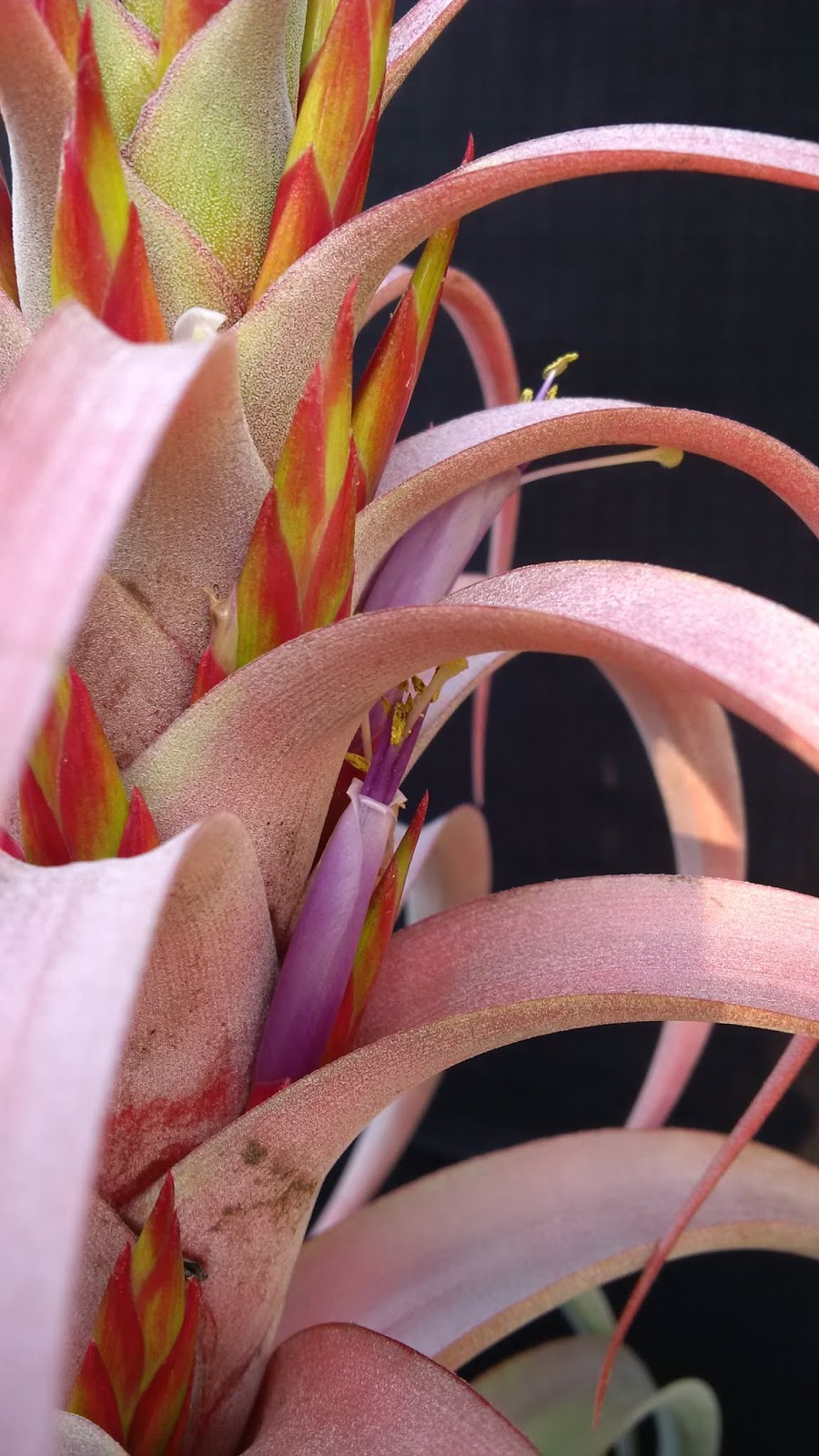
THE PARTS OF A FLOWER;
- The idea is to get the pollen onto "something" and transfer it to the stigma of another flower. And sometimes the stigma and/or the anthers are hidden within the flower. You can use toothpicks, sharply pointed paint brushes etc. I like to use home made "brushes" consisting of paint brush bristles, something to adhere it to, thread and glue to give the final touch. The pics will give you an idea.
- If there are enough flowers and the anthers are protruding.... and I really need to pollinate, I will sometimes take the whole flower and use it to transfer pollen onto the stigma of another flower.
- And it does seem that different species stigma is not ready at the same time to receive pollen at the same time. Stigma that is ready, becomes quite sticky. Doing the same fertilization more than ones a day may be a good practice.
- And if you are an serious breeder, you will have to do like natural pollinators do and "destroy" the flowers of plants that self pollinate. The pollen will have to be removed before pollination takes place and then the pollen of the other plant can be transferred to the stigma. The flowers are normally very small on these ones: "The self-pollinating (cleistogamous) Tillandsia subgenus is
Diaphoranthama and it includes all the miniature species such as T.
usneoides, T. capillaris, T. recurvata, T. angulosa, etc." -Paul T.
Isley III (I have not done this myself.)
It will take weeks/ months for the seeds to grow out, and sometimes the seed capsule will stay hidden and then suddenly appears. Here is an example of a seed capsule in T. loliacea.
The trick is now to catch the seed - they will fly away in the wind if not caught in time. One can make a small net from nylon stockings or the like.
If left to its own devices the pod will burst open and the fluffy seed caught. Sow them as soon as possible on something that will keep them set but dry of quickly.
The natural way:
Twigs
Bark
Lala palm seeds.
Or any other natural host. Cork works well also.
Other methods I use is nylon stockings stretched over wire. First kept horizontal and later I hang them vertically.
A seed:
After spreading the seeds I use a spray bottle to wet them. The seeds swell out quickly and after a day or two in strong light - they start to photosynthesize.
Once they have germinated and the first two leaves visible, they are quite hardy. I only water mine when I water the bigger plants. They do love good air movement.
March 2020 - Did sow Tillandsia fasciculata (Central American Pink) seed today. I spread them dry and then spray them until they are very wet.
I do miss some seeds and when they have germinated and grown out a bit, I do remove them to small sticks. I also take seedlings riding along on bought plants and mount them always - who knows what these lucky packets will reveal!
This is my largest seedling. An unknown Tillandsia ionantha: