WHAT IS BAP?
6-Benzylaminopurine, benzyl adenine, BAP or BA is a first-generation synthetic cytokinin that elicits plant growth and development responses, setting blossoms and stimulating fruit richness by stimulating cell division.I came into contact with this when I grew orchids and I needed it to promote keikies (growths) on orchids flowering stems. It is mostly used on Phalaenopsis because they do this naturally and sometimes just pushing them making a keiki and not another stalk on a node. I had some success with it, but not "WOW" results. I used wool fat as to hold the Bap after dissolving it with
sodium hydroxide. I remember that it was suggested that it could be used to promote pupping on Tillandsia.
Loving to experiment I found the little bottle stashed away in a box and decided to experiment on Tillandsia. After dissolving a pinch of BAP in citric acid and then with 500ml of water, the experiment began!
I used two Tillandsia xerographica from the same source in flower. The plants were almost the same size also. This is when I recieved the plants in January 2018:
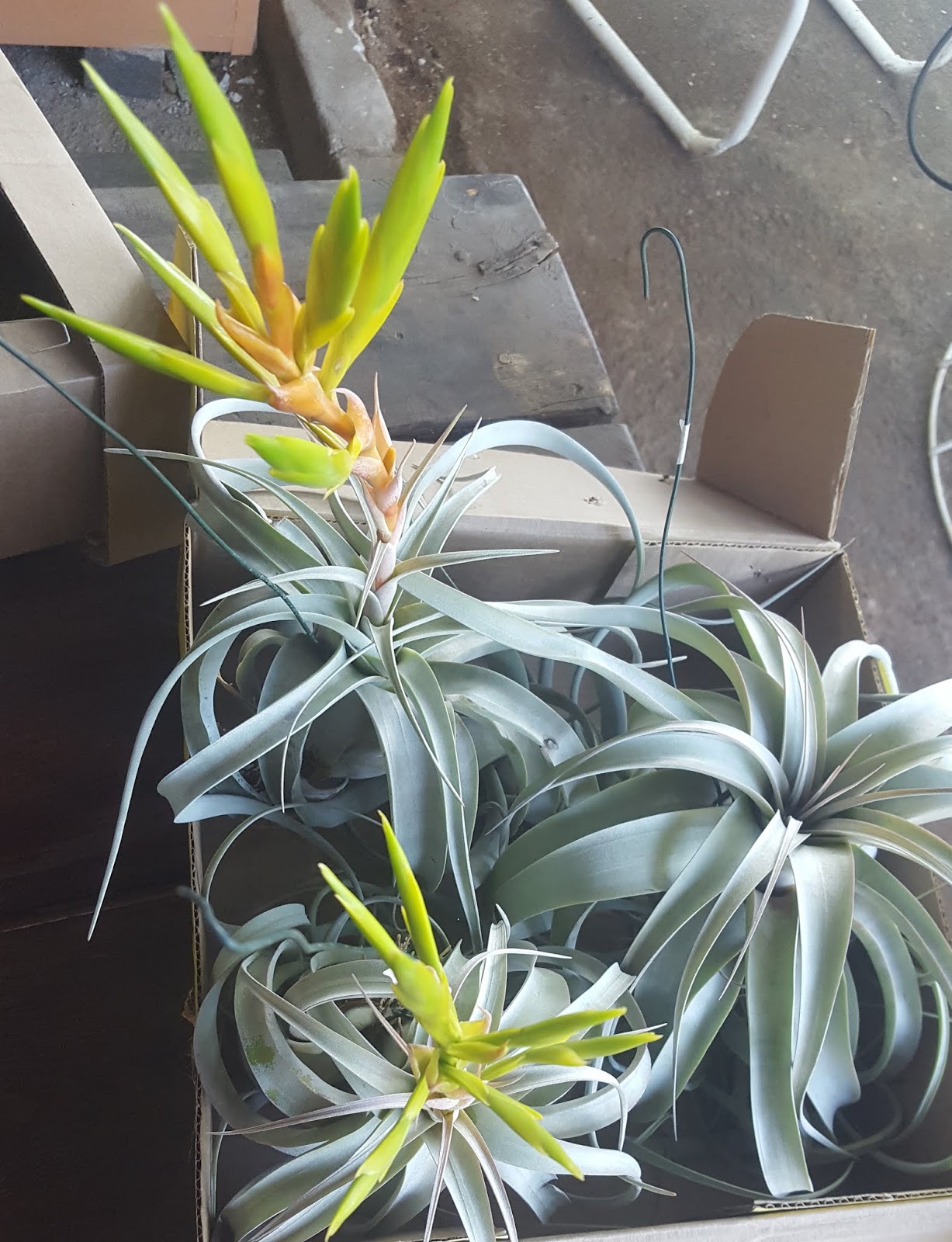
I sprayed the plant with the solution a few times a day and probably over a weeks time. I made sure that the whole plant was sprayed. This one was chosen for the experiment:

This is the control plant:

This is the control plant with one pup in April 2019. I also got one seed pod!

The treated plant also in April 2019. 9 pups formed on this plant, but they were much smaller than the control plant's pup.

I removed the pup on the control plant to hopefully get more pups.
This is the comparison between the removed pup and the ones on the treated plant in June 2019.

The treated plant in October 2019. I removed the two biggest pups.

4 more pups were removed in November 2019. The yellow powder is flowers of sulfur.

This is the treated plant in March 2020. It seems that the growth of the last 3 pups are suppressed, because there is very little growth on them.


With no scientific certainty, I do believe that BAP promotes the forming of pups, but probably also act as a growth retardant. Will post pics of the pups that were removed, soon.
30 March 2020:
One of the pups removed in November 2019 is pupping! It seems that the hormones has mixed up the plant normal growth pattern.

Any comments welcome.
Comment from
Richard King I
have used 6BAP . I use it in my plant tissue culture lab to induce
multiplication in orchids such as Cattleya and Oncidium - and have also
done some trials on Tillandsia - 50mg/L applied weekly for ten weeks. I
got amazing results - a tomaselli gave
me 17 pups. The problem is that BA is very strong, and can cause growth
defects and mutations (seldom if ever advantageous). Nature has checks
and balances, and if it gives, it also takes - Plants have a very finely
tuned balance between the different plant growth regulators
(hormones).They act in synergy. For example, auxins at the apex of the
plant suppress the activity of cytokinins in the axillary meristems - So
the plant is a finely tuned clock, and throwing a lot of BA into the
system is going to upset the balance. You may get deformed pups, or pups
that flower prematurely. ie, it can send the plant into overdrive,
almost like a cancer.
I
have used 6BAP . I use it in my plant tissue culture lab to induce
multiplication in orchids such as Cattleya and Oncidium - and have also
done some trials on Tillandsia - 50mg/L applied weekly for ten weeks. I
got amazing results - a tomaselli gave
me 17 pups. The problem is that BA is very strong, and can cause growth
defects and mutations (seldom if ever advantageous). Nature has checks
and balances, and if it gives, it also takes - Plants have a very finely
tuned balance between the different plant growth regulators
(hormones).They act in synergy. For example, auxins at the apex of the
plant suppress the activity of cytokinins in the axillary meristems - So
the plant is a finely tuned clock, and throwing a lot of BA into the
system is going to upset the balance. You may get deformed pups, or pups
that flower prematurely. ie, it can send the plant into overdrive,
almost like a cancer.
I
have used 6BAP . I use it in my plant tissue culture lab to induce
multiplication in orchids such as Cattleya and Oncidium - and have also
done some trials on Tillandsia - 50mg/L applied weekly for ten weeks. I
got amazing results - a tomaselli gave
me 17 pups. The problem is that BA is very strong, and can cause growth
defects and mutations (seldom if ever advantageous). Nature has checks
and balances, and if it gives, it also takes - Plants have a very finely
tuned balance between the different plant growth regulators
(hormones).They act in synergy. For example, auxins at the apex of the
plant suppress the activity of cytokinins in the axillary meristems - So
the plant is a finely tuned clock, and throwing a lot of BA into the
system is going to upset the balance. You may get deformed pups, or pups
that flower prematurely. ie, it can send the plant into overdrive,
almost like a cancer.
Comment from
Frank Bezuidenhout 6BAP
works well on Tillandsia but better on some species than other.
Xerographica may not have been the best choice for it's extremely slow
growth rate. It does however require a bit more science than a "pinch"
dissolved on NaOH. It needs to be brought
very accurately to a standard solution (1ml = 1mg) and neutralised with
HCL before diluting to your required strength. I have never seen or
heard of it applied 3 times a day over such a short period but rather at
lower dosage 2 to 3 times a week for between 6 to 12 weeks depending on
dosage selected. You have possibly hugely overdosed with what is
essentially a growth tip retarder, which would explain your slow
inferior growth of the test pups. Normally it is also applied to plants
that have already done flowering. I have dabbled in 6BAP and had great
success with plants like Cacticola for example with a seasonal growth
cycle.......
Interesting how these double flowers were formed on Euphorbia milii Thai hybrid.

Removed two more pups from the mother plant. The one is a bit stunted, but it will survive. Now there is one pup left. The mother gave me 9 pups.....I think it is almost done.